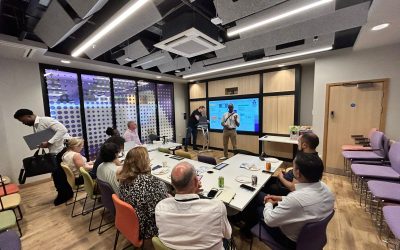
BIZTECH INNOVATION ROUNDTABLE REPORT 25TH MARCH 2026
The latest Biztech Innovation Roundtable brought together industry experts, SME leaders, and robotics practitioners for a deep dive into one of the most transformative opportunities facing UK businesses today: the adoption of robotics by small and medium‑sized enterprises. The session featured expert presentations from Andrew Brock (Manufacturing Technology Centre), Ian Pulford (Smart City Consulting), and Dr Gilbert Tang (Cranfield University), each exploring a different dimension of the robotics landscape — from manufacturing automation to outdoor autonomy and next‑generation AI‑driven robots.
This roundtable offered practical insights, honest discussion, and a realistic look at where robotics adoption stands today — and where it is heading.
Barriers and Opportunities: Robotics in Manufacturing
Speaker: Andrew Brock, Manufacturing Technology Centre

Andrew opened the session by addressing a familiar challenge for SMEs: bridging the gap between interest in automation and real‑world implementation. He highlighted several core barriers — traditional capital expenditure, integration complexity, and limited in‑house expertise — that often slow adoption.
But the landscape is shifting.
Andrew explained how new commercial models, including robot leasing and robots‑as‑a‑service (RaaS), are making automation more financially accessible. Modular systems and collaborative robots are helping SMEs deploy automation faster and with lower risk. He also shared a practical framework for judging when automation is worth it, pointing to repetitive processes, production bottlenecks, safety improvements, and quality control as strong indicators.
Autonomy as a Service: Robots in Public Spaces
Speaker: Ian Pulford, Smart City Consulting
Ian’s presentation explored autonomy beyond the factory — into cities, public spaces, and outdoor environments. He provided an inside look at Smart City Consulting’s work on pavement robots, autonomous shuttles in Milton Keynes and Solihull, and new platforms such as Adibot and CAPRA.
A recurring theme was the importance of connectivity for safety-critical robotics. Many of their systems depend on low-latency 5G networks to support safe remote monitoring and control. Ian also touched on partnerships with local councils and education providers, including an impressive pipeline of robotics talent emerging from collaborations with Cranfield University.
Skills, Training, and the Future of AI-Driven Robotics
Speaker: Dr Gilbert Tang, Cranfield University

Gilbert emphasised what many SMEs overlook: the success of robotics adoption depends as much on skills and organisational readiness as it does on technology.
He defined robots as reconfigurable, general‑purpose machines well suited to the “4Ds” — dull, dirty, dangerous, and dear tasks — and introduced current state‑of‑the‑art technologies including collaborative robots and autonomous mobile robots.
Gilbert also explored the rapid evolution of AI-driven robots, including systems powered by large language models capable of interpreting verbal instructions. His team has been integrating LLMs into robotics for several years, and he anticipates seeing these technologies in real applications within 2–3 years. He noted that executive-level awareness and training remain key barriers in the UK, despite fast-moving international developments.
Humanoids, Specialist Robots, and the Form Factor Debate
A lively discussion unfolded around the question of robot form factors — should SMEs focus on specialised machines, or prepare for a future of humanoid and animal-like robots?
Andrew argued in favour of humanoid formats for their ability to work in human‑designed environments. Ian and other participants noted the importance of scalability and affordability, suggesting that simpler general-purpose robots may deliver faster ROI for SMEs. The group also considered current industry examples, including entertainment robots and delivery robots already operating across Milton Keynes.
The Connectivity Challenge: Latency, Resilience, and Local Decision-Making
Both Ian and Andrew addressed technical constraints around robotics deployment. Outdoor robots and remote operations depend on ultra‑low-latency communications — ideally under 40 ms — to ensure safe intervention when needed.
At the same time, Andrew stressed the importance of local autonomy, allowing machines to make critical decisions even if connectivity dips. This decentralised approach is essential for robotics in both factory and field environments.
Adoption Drivers: Skills Gaps, Labour Shortages, and Real SME Needs
The panel agreed that SMEs are increasingly looking to robotics out of necessity. Labour shortages — particularly in skilled roles like welding — are accelerating the shift towards automation. While the UK is strong in certain robotics niches, all three speakers acknowledged that international competitors (notably China) are advancing quickly, largely due to stronger skills pipelines and faster deployment cycles.
Closing Reflections
Biztech Founder Fredi Nonyelu closed the session by thanking all speakers and attendees, noting the high level of engagement and the growing appetite for robotics within the SME community. He announced that further roundtables and innovation events are planned over the coming months and encouraged participants to stay connected through the Biztech newsletter and LinkedIn.
Robotics adoption is no longer aspirational — it is becoming a practical and essential strategy for SMEs seeking resilience, productivity, and competitive advantage. As this roundtable made clear, the UK’s opportunity lies not only in adopting the technology, but in building the skills, partnerships, and governance needed to use it well.