
AI as a Productivity Multiplier
The most immediate benefit SMEs see from AI is productivity. Tools for automation, summarisation, coding assistance, and workflow optimisation can reduce time spent on repetitive tasks by 30–50%. For example:
- AI copilots streamline documentation, meeting notes, and email drafting.
- Automation platforms handle routine operations like ticket triage, invoicing, and customer queries.
- AI‑assisted development accelerates prototyping, debugging, and testing.
For SMEs with lean teams, these gains translate directly into increased capacity without increasing headcount. The organisations adopting AI early often report that staff can redirect time toward higher‑value work—client engagement, innovation, and strategic planning.
Ai doesn’t replace people, it enhances and facilitates existing teams to be more productive and remain competitive.
Use Cases That Deliver Fast Wins
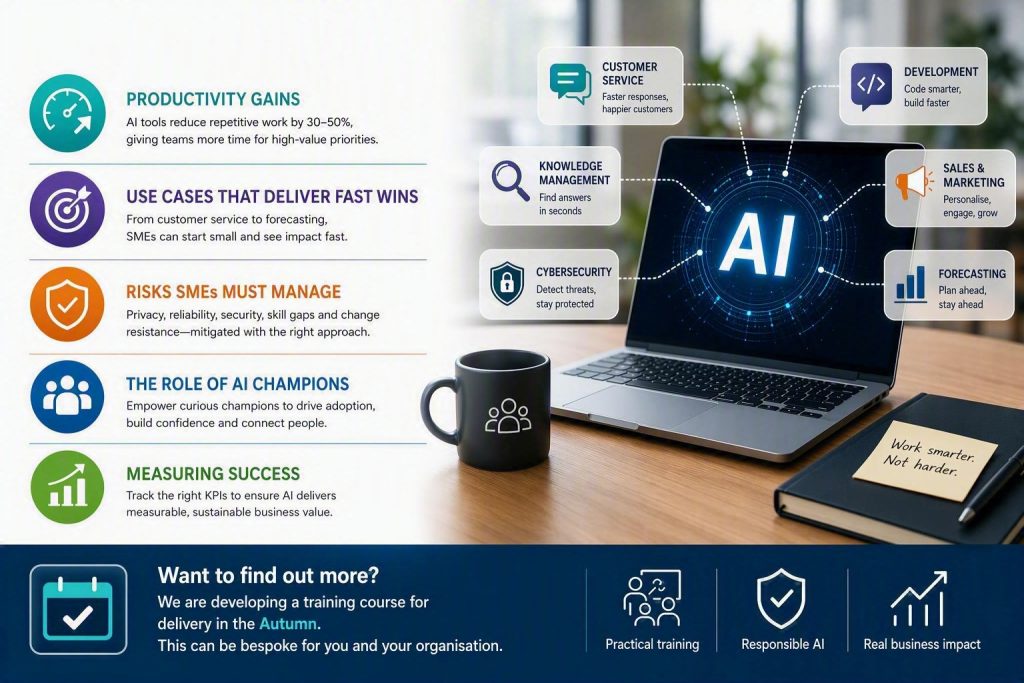
SMEs don’t need to start with complex machine‑learning projects. The most successful early adopters begin with targeted, high‑impact use cases:
- Customer service augmentation: AI chatbots and triage systems reduce response times and improve consistency.
- Sales and marketing optimisation: AI tools analyse customer behaviour, personalise outreach, and generate content.
- Internal knowledge management: AI search and summarisation reduce time spent hunting for information.
- Cybersecurity monitoring: AI‑driven anomaly detection strengthens security without needing a large SOC team.
- Operational forecasting: Predictive analytics help SMEs anticipate demand, staffing needs, and supply chain issues.
These use cases don’t require bespoke models—off‑the‑shelf AI platforms can deliver immediate value.
Risks SMEs Must Manage
AI adoption isn’t risk‑free. The most common challenges SMEs face include:
- Data privacy and governance: Ensuring sensitive information isn’t exposed to external systems.
- Model reliability: AI can hallucinate, misinterpret, or produce inconsistent outputs.
- Security vulnerabilities: Poorly configured AI tools can introduce new attack surfaces.
- Skill gaps: Staff may not understand how to use AI effectively or safely.
- Change resistance: Teams may worry AI will replace roles rather than enhance them.
Mitigating these risks requires clear policies, training, and a deliberate rollout strategy—not ad‑hoc experimentation. Human oversight is essential and humans should remain responsible.
The Role of AI Champions
One of the strongest predictors of successful AI adoption is the presence of AI champions inside the organisation. These are not necessarily technical experts—they are curious, pragmatic individuals who:
- Identify suitable use cases
- Test tools and validate value
- Train colleagues
- Promote responsible usage
- Act as the bridge between leadership and technical teams
SMEs with active AI champions typically adopt AI 2–3× faster and with significantly higher staff engagement.
Measuring Success
To ensure AI adoption delivers real value, SMEs should track:
- Time saved per workflow
- Reduction in operational costs
- Improvement in customer satisfaction metrics
- Accuracy and reliability of AI‑generated outputs
- Employee adoption and satisfaction
- Revenue uplift from AI‑enhanced services
Clear KPIs prevent AI from becoming a novelty and instead anchor it as a strategic capability.
Want to find out more? We are developing a training course for delivery in the Autumn. This can be bespoke for you and your organisation.
Go to Biztech Stories for more like this from the Biztech Consulting Team.