Rebuilding Intelligence: From Living Systems to Human Impact
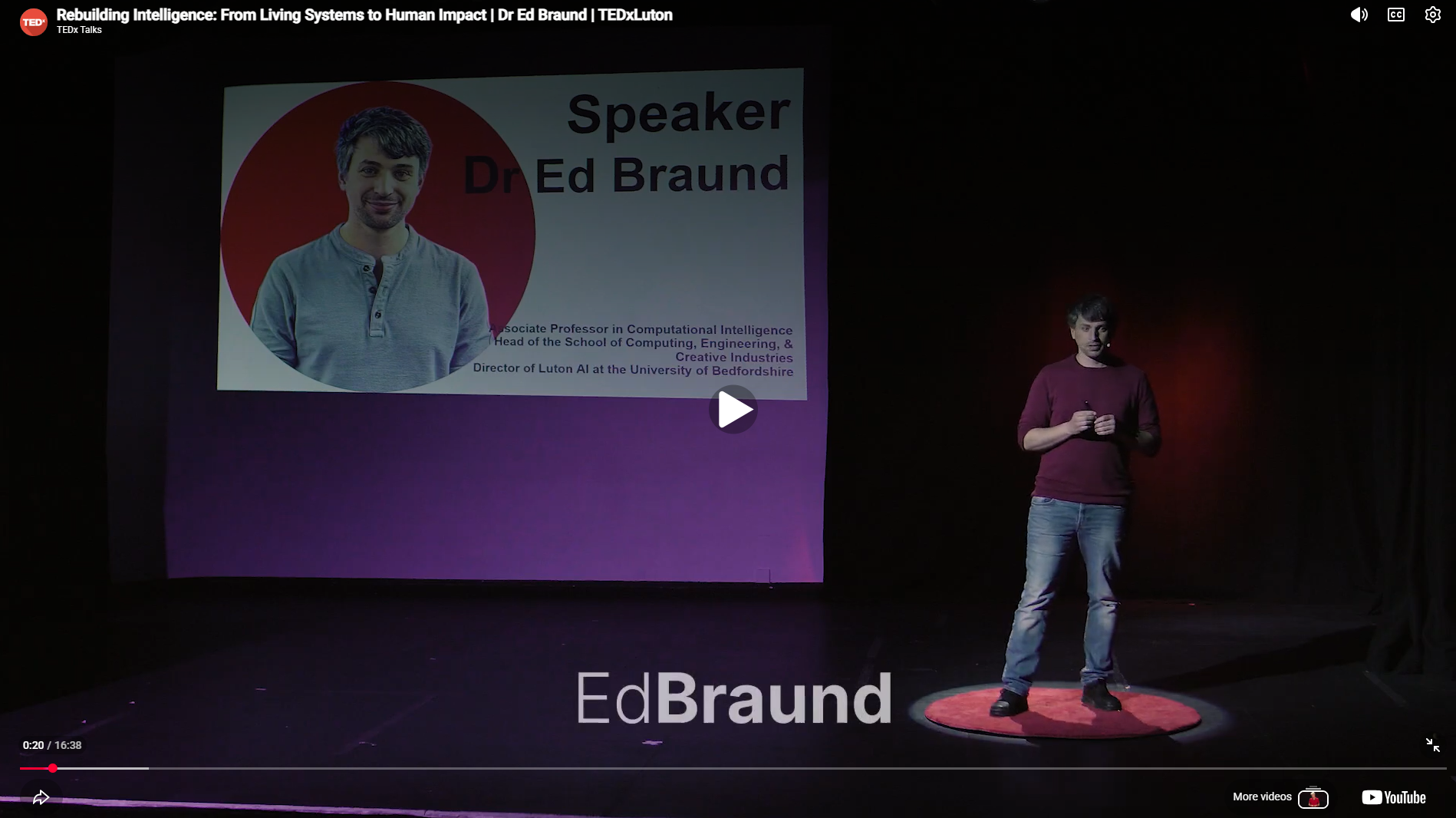
In his TEDxLuton talk, Rebuilding Intelligence: From Living Systems to Human Impact, Dr Ed Braund challenges the conventional understanding of intelligence in the age of AI. Instead of viewing intelligence as something engineered and contained within algorithms, he reframes it as something that emerges from dynamic, interconnected systems—much like those found in nature. For the Biztech community, this perspective offers a powerful lens for rethinking how technology and business intersect.
Intelligence is Not Artificial
At the heart of Braund’s argument is the idea that intelligence is not artificial—it is systemic. In living systems, intelligence arises through interaction, adaptation, and feedback. Whether in ecosystems or the human brain, it is not a single component but the relationships between components that create intelligent behaviour. This stands in contrast to many enterprise AI initiatives, which still treat intelligence as a technical capability rather than an organisational one.
For business and technology leaders, this insight is critical. AI tools alone do not create intelligence; they must be embedded within environments that support learning, collaboration, and adaptation. In other words, intelligent organisations are not built on technology alone, but on the integration of people, processes, and systems working together.
Distinguish between Data Processing and Meaning Creation
Braund also distinguishes between data processing and meaning creation. While machines excel at analysing large volumes of data, true intelligence involves interpreting that data in context and using it to inform purposeful action. Many organisations today focus heavily on automation, efficiency, and prediction accuracy. While these are valuable, they often overlook the deeper question of impact: how technology enhances human decision-making and creates real-world value.
This is where the shift from automation to augmentation becomes important. Rather than replacing human intelligence, the goal should be to extend it—enabling better insights, more informed decisions, and improved outcomes. For the BizTech community, this means designing systems that empower users, not sideline them.
Relational Nature of Intelligence
As networks become more intelligent and more pervasive, they also become more critical — and more vulnerable. Today’s encryption relies on mathematical problems that classical computers struggle to solve. Quantum computers, however, could break many of these systems in minutes, creating a vulnerability.
Rebuilding Intelligence: A Systems Design Standpoint
From a systems design standpoint, he advocates for models inspired by living systems—adaptive, decentralised, and resilient. In a world defined by uncertainty and rapid change, rigid architectures quickly become outdated. Instead, organisations should build systems that can evolve, respond to feedback, and thrive under changing conditions.
Ultimately, Braund brings the conversation back to human impact. Intelligence, whether natural or artificial, should serve a purpose beyond efficiency. It should improve lives, enhance experiences, and contribute positively to society. This aligns with the growing focus on responsible AI and purpose-driven innovation.
Conclusion: Intelligence is something you cultivate
For leaders, the message is clear: intelligence is not something you deploy—it’s something you cultivate. By embracing systems thinking, prioritising human-centred design, and aligning technology with meaningful outcomes, organisations can move beyond isolated AI solutions to build truly intelligent ecosystems.
In a landscape increasingly defined by automation, Braund’s talk is a timely reminder that the future of intelligence is not artificial—it is integrated, adaptive, and human.
Dr. Ed Braund is Head of School at University of Bedfordshire and sits on the advisory board for Biztech Technology Forum Ltd.
Go to Biztech Stories for more like this from the Biztech Consulting Team.