What is knowledge?
Before we can explore what knowledge SMEs need, we need to understand a couple of definitions.
knowledge /ˈnɒlɪdʒ/ noun: knowledge; plural noun: knowledges
- facts, information, and skills acquired through experience or education; the theoretical or practical understanding of a subject.
- awareness or familiarity gained by experience of a fact or situation.
So, who are these people and what do they have in common?

They are: Aristotle, Archimedes, Leonardo da Vinci, Sir Isaac Newton, Albert Einstein and Ada Lovelace.
They are all famous historical polymaths!
polymath /ˈpɒlɪmaθ/ noun: polymath; plural noun: polymaths
A person of wide knowledge or learning.
Through history it was possible for individuals to contribute to and advance significantly the sum total of human knowledge across several fields.
There are modern people also considered to be polymaths as they are recognised across several skills/professions – e.g.:
Elon Musk, Arnold Schwarzenegger, Felicia Day, Dolph Lundgren, Bruce Dickinson, Jonny Kim, Brian May, Viggo Mortensen….
But the pace of change is ever accelerating
There are many ways to consider this, but here are a couple looking at how long knowledge has taken to double and how many patents have been granted.
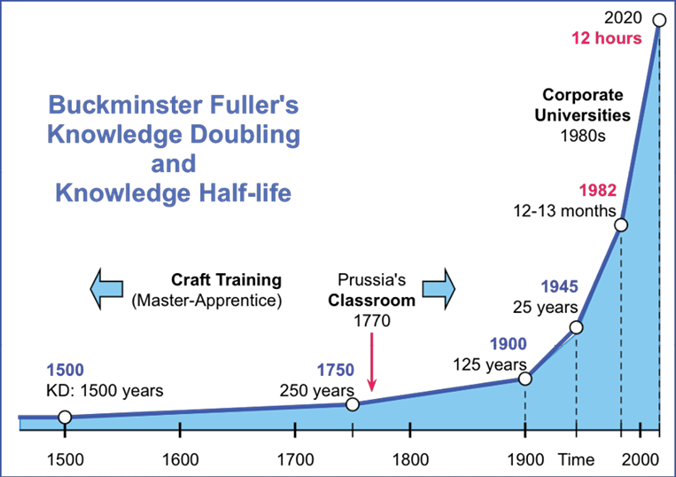
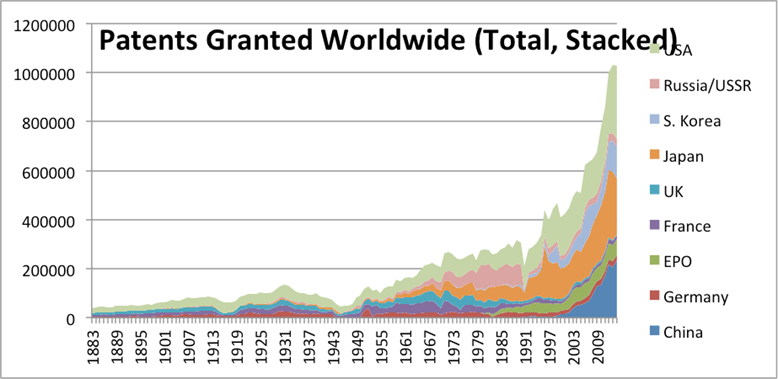
Also, attributed to Derk de Solla Price:
“90% of All the Scientists That Ever Lived Are Alive Today (starting from 1900)”
Which was from his book of 1961! – So this is not a recently recognised phenomenon!
So it is now not possible to be a real cutting edge “expert” acreoss multiple disciplines.
How can we visualise knowledge shape
To visualise depth versus breadth of knowledge these shapes have been used:
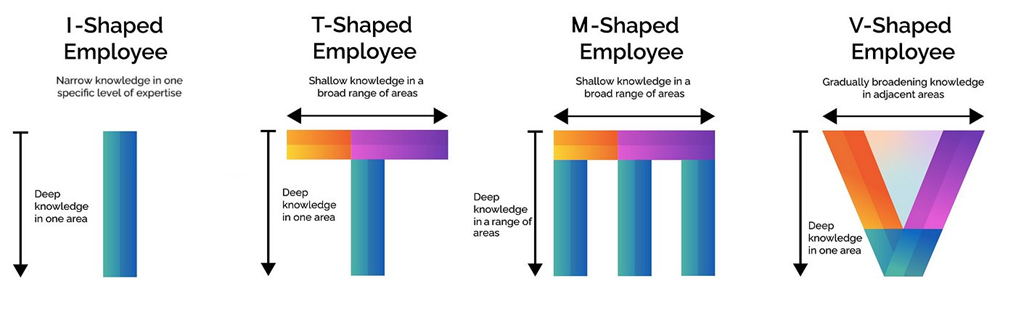
“Highly successful 21st century professionals tend to be ‘key shaped’” (Ruth Bridgstock 2015)
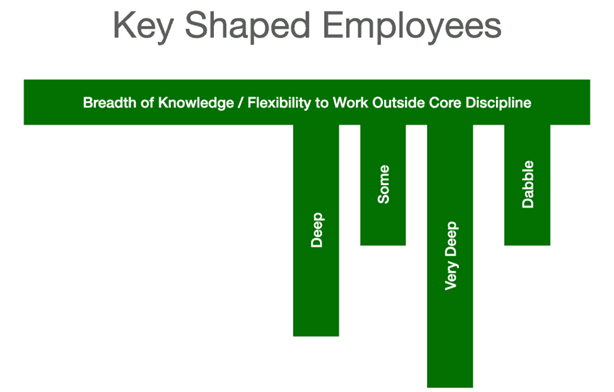
But what has this all to do with SMEs?
Well this all applies not just employees, but companies, organisations and particularly to SMEs!
Many SMEs are founded by innovators or entrepreneurs who have a vision, mission or simply invent/develop something novel.
But with the pace of change and expansion of technologies and their interconnectivity, the total scope for even SMEs rapidly encompasses many/most of these:
Disciplines – Mechanical, Electrical, Electronics, Pneumatics…
Hardware – Manufacturing, Tooling, 3D Printing, AM, Assembly, PCBs, Testing…
Design – Concept, Industrial Design, Usability, Sustainability…
Simulation – Multi-Physics, SPICE, Digital Twins…
Software – Embedded/Firmware, High/Low-level, Stack, Languages, GUI/HMI, AI/ML, Localisation, Version Control…
Data – Analysis, Visualisation, Databases, Spreadsheets, Matlab…
Life-cycle – Support, Troubleshooting, Maintenance, Recycling…
Compliance – Standards, Certifications, GDPR, Cyber Secuity, CE/CA Marking…
Business – Finance, Accounting, Plans, Marketing, PR, HR, ESG, Patents, Health and Safety…
So organisations lile SMEs, as a whole, need to have “key shaped” knowledge.
So how can this be achieved?
As SMEs grow, then inevitably, they need more employees who will bring in more depth and breadth of knowledge.
However, in the meantime there are a number of ways to broaden and deepen within the inevitable constraints.
Skills training which needs to include “soft” skills as well as “hard” skills to promote communication and collaboration between and within teams and departments.
Use of business advisors, coaches, mentors and of course consultants.
However a key consideration is to ensure that vital knowledge is built up within the organisation, rather than relying on external sources. There are various ways to help to make this possible, including:
Grant Funding through growth hubs, Innovate UK competitions, etc.
Knowledge Transfer Partnerships (KTPs) with academia.
Accelerator schemes – Run by various organisations including banks, UK Research and Innovation (UKRI), etc.
CPD – Through Engineering Institutions, British Computer Society (BCS, the Chartered Institute for IT), etc.
Various support organisations – Such as the Federation of Small Businesses (FSB) and ACT | The App Association
Specialised organisations that run Events, Workshops, Hackathons, etc.
Please contact me or Biztech if you need any specific assistance or contact details for any of the above.