
Three Technologies Defining the Next Decade of Telecom
For decades, telecom progress has been measured in megabits and milliseconds. Each generation of mobile technology delivered a familiar promise: faster downloads, smoother streaming, more bandwidth. But as we look toward the 2030s and the rise of 6G, that metric is changing. The next leap forward won’t be defined by data rate alone, but by adaptability, reach, and security.
Three technologies in particular are set to reshape the very nature of connectivity.
1. AI‑Native Networks: The Self‑Healing Nervous System
Artificial Intelligence is already used to optimise data throughput or automate routine tasks, but the next decade will see AI woven directly into the architecture of telecoms networks. In an AI‑native system, intelligence isn’t an add‑on — it’s the operating principle.
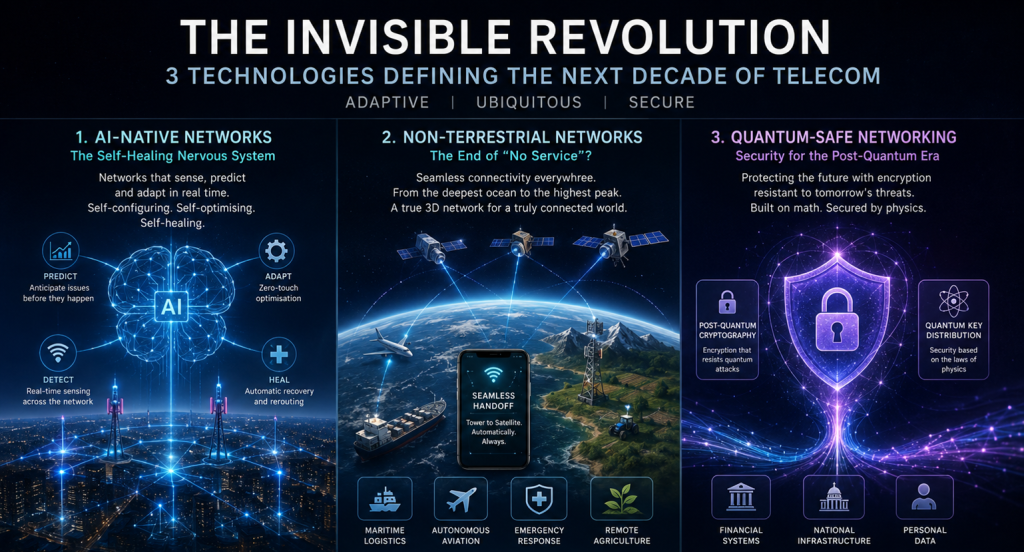
These networks behave like a biological nervous system: sensing, predicting, and adapting in real time. Through “zero‑touch” adaptation, they can self‑configure, self‑optimise, and self‑heal. A sudden spike in demand, a failing radio unit, or a fibre cut becomes just another stimulus the network responds to automatically. Instead of waiting for outages, predictive models will anticipate failures and reroute traffic before users notice anything at all. By the mid‑2030s, downtime could shift from a routine annoyance to a rare anomaly.
2. Non‑Terrestrial Networks: The End of “No Service”?
Coverage has always been the telecom industry’s hard limit. Mountains, oceans, deserts, and sparsely populated regions create unavoidable dead zones. Non‑Terrestrial Networks (NTN) aim to eliminate them entirely by integrating satellite-based connectivity directly into the cellular ecosystem.
One of the emerging models is “direct‑to‑device” connectivity: your ordinary smartphone seamlessly hands off from a terrestrial tower to a low‑Earth‑orbit satellite when needed. The other model is using satellite communications for high data rate connectivity for backhauling data, for example connecting a remote cell tower to the network backbone. The result is a true ‘3D’ network that wraps the entire planet in coverage. For industries like maritime logistics, autonomous aviation, emergency response, and remote agriculture, this is transformative. Global automation becomes possible only when connectivity is genuinely global.
3. Quantum‑Safe Networking: Security for the Post‑Quantum Era
As networks become more intelligent and more pervasive, they also become more critical — and more vulnerable. Today’s encryption relies on mathematical problems that classical computers struggle to solve. Quantum computers, however, could break many of these systems in minutes, creating a vulnerability.
Telecom operators are now racing to deploy quantum‑safe security. Post‑Quantum Cryptography (PQC) provides algorithms resistant to quantum attacks, while Quantum Key Distribution (QKD) uses the laws of physics to secure communication: since quantum states change when observed, any attempt to intercept a QKD key is immediately detectable. By the 2030s, quantum‑safe networking will be essential for protecting financial systems, national infrastructure, and personal data.
The Integrated Future
These technologies reinforce one another. AI will manage the complexity of complex ‘3D’ networks. Quantum‑safe protocols will secure the vast data flows of this global, intelligent fabric. For users, the outcome will feel simple: a network that is always available, always optimised, and fundamentally secure.
The next decade isn’t just another upgrade. It’s the moment the network stops being a utility and becomes an intelligent, planetary‑scale system — one that quietly works in the background, everywhere, all the time.
Go to Biztech Stories for more like this from the Biztech Consulting Team.