

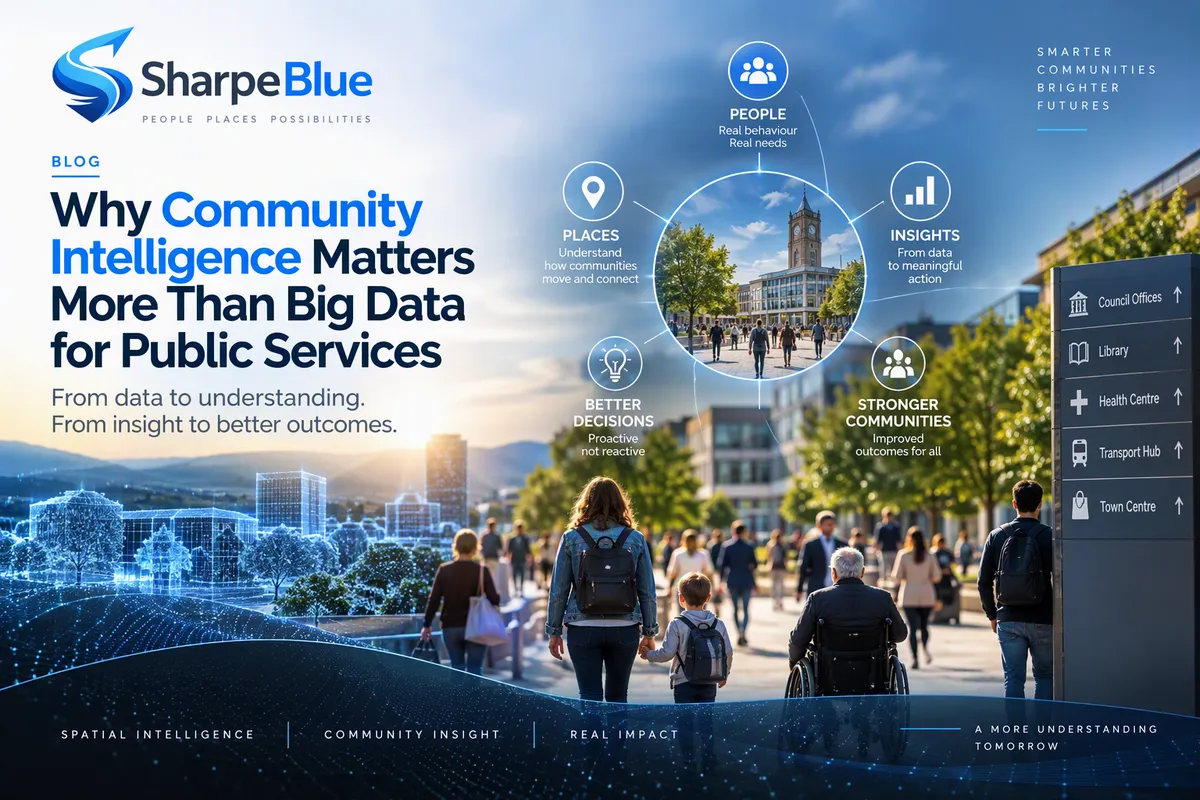
Why Community Intelligence Matters More Than Big Data for Public Services
Public services have never had more data at their disposal. Councils collect information on housing, transport, health, education, footfall, service usage, and demographics. Healthcare providers monitor performance metrics and patient outcomes. Transport operators track journeys and network performance in near real time.
Yet despite this abundance of data, many organisations still struggle to answer a fundamental question:
What is really happening in our communities?
The challenge is not a lack of information. It is a lack of understanding.
This is where community intelligence becomes critical.
The Big Data Problem
For more than a decade, public sector transformation has been driven by the belief that more data leads to better decisions.
Data is undoubtedly valuable. It tells us:
• How many people used a service
• Where incidents occurred
• Which areas experience the highest demand
• How performance measures compare over time
But data often tells us what happened, not why it happened.
A spike in anti-social behaviour, declining participation in community programmes, increasing demand for social care, or falling visitor satisfaction can all be identified through data. Understanding the human factors behind those patterns is often much more difficult.
This is the gap between information and insight.
What Is Community Intelligence?
Community intelligence is the ability to understand how people, places, behaviours, and services interact within a community.
It combines multiple perspectives:
• Human behaviour
• Spatial patterns
• Local knowledge
• Service interactions
• Lived experiences
• Environmental context
Rather than viewing communities as collections of statistics, community intelligence views them as dynamic systems of relationships and activity.
The goal is not simply to measure outcomes.
The goal is to understand the factors driving those outcomes.
Seeing the Patterns Hidden in Plain Sight
Many challenges facing public services emerge long before they appear in reports or dashboards.
A town centre may feel less welcoming before visitor numbers start to decline.
Patients may experience increasing anxiety before missed appointments become evident.
Communities may become socially isolated before healthcare demand rises.
Residents may avoid public spaces long before surveys reveal dissatisfaction.
Traditional reporting often captures these issues after they have become significant.
Community intelligence helps organisations identify early signals before they develop into major problems.
Why Context Matters More Than Volume
Public sector leaders often ask for more data when facing uncertainty.
However, collecting more information does not automatically create better understanding.
In many cases, the missing ingredient is context.
For example:
A transport authority may know that passenger numbers have fallen.
Community intelligence seeks to understand:
• Which groups are travelling less
• Whether accessibility barriers exist
• How confidence, safety, or convenience influence behaviour
• Which interventions could have the greatest impact
Similarly, a healthcare provider may know appointment attendance rates.
Community intelligence helps reveal:
• Why certain groups miss appointments
• Where navigation challenges create barriers
• How environmental factors influence patient experiences
• Which populations may require additional support
The difference is profound.
One approach measures activity.
The other explains behaviour.
Moving From Reactive to Predictive Public Services
The most effective public services are increasingly shifting from reactive models to proactive ones.
Rather than responding to problems after they occur, organisations are seeking ways to identify emerging needs earlier.
Community intelligence supports this shift by revealing:
• Early indicators of demand
• Changes in behaviour patterns
• Emerging accessibility challenges
• Areas of service inequality
• Opportunities for early intervention
By understanding how communities interact with services and places, organisations can make better decisions before pressures escalate.
The Role of Spatial Intelligence
Community intelligence becomes even more powerful when combined with spatial intelligence.
Where people move, gather, wait, access services, or experience barriers tells us a great deal about how communities function.
Spatial intelligence helps organisations answer questions such as:
• Which communities have the poorest access to services?
• Where do visitors encounter friction in their journeys?
• Which public spaces create the greatest barriers to participation?
• How can resources be deployed more effectively?
Understanding location is often the key to understanding behaviour.
Building Better Public Services
The future of public services will not be defined by who collects the most data.
It will be defined by who understands people the best.
Data remains essential. But data alone cannot explain community needs, uncover human behaviour, or reveal the lived experiences behind service demand.
Community intelligence bridges that gap.
It transforms data into understanding, understanding into action, and action into better outcomes for citizens.
At SharpeBlue, we believe the next generation of public services will be powered not simply by technology, but by a deeper understanding of the communities they serve.
Because better decisions begin with better insight.
And better insight starts with community intelligence.
