

Businesses are investing more than ever in new technologies. Artificial intelligence, automation, advanced analytics, digital platforms, and connected systems promise to transform operations, improve customer experiences, and unlock new opportunities for growth.
Yet despite these investments, many organisations struggle to achieve meaningful results.
The reality is that most innovation project failure occurs long before technology becomes a factor.
The problem is rarely the software, platform, or technology itself. More often, organisations fail because they focus on solutions before fully understanding the challenge they are trying to solve.
For organisations developing an innovation strategy, this distinction can make the difference between successful business transformation and expensive disappointment.
The Technology Trap: A Common Innovation Mistake
Many innovation initiatives start in a familiar way.
A leadership team attends an industry event, reads about the latest technology trend, or hears a compelling case study from another organisation. Excitement builds around the potential benefits. New systems are proposed. Budgets are allocated. Pilot projects are launched.
The question that often gets overlooked is:
What problem are we actually trying to solve?
Instead of starting with a business challenge, organisations start with a technology solution and then search for a problem that justifies it.
This approach creates significant risk because technologies do not create value on their own. Value is created when technology helps solve a meaningful problem, improve a process, reduce costs, increase productivity, or create new market opportunities.
A successful innovation strategy should always begin with understanding the challenge before evaluating potential solutions.
Why Innovation Projects Fail
While every project is different, there are several recurring causes of innovation project failure.
1. The Problem Is Poorly Defined
One of the biggest barriers to business innovation is a lack of clarity about the challenge being addressed.
Different stakeholders may have different assumptions about the problem. Leadership teams may see one issue while frontline staff experience another. Customers may identify frustrations that internal teams have never considered.
Without a clearly defined problem, even the most advanced technology is unlikely to deliver meaningful outcomes.
2. Success Criteria Are Unclear
Many organisations launch innovation initiatives without defining measurable objectives.
Questions such as these should be addressed from the outset:
- What specific outcome are we seeking?
- How will we measure success?
- What business value do we expect to create?
- What should improve for customers, employees, or stakeholders?
If success cannot be clearly defined, it becomes difficult to evaluate whether the innovation is delivering value.
3. Technology Becomes the Objective
Technology should support business outcomes, not become the outcome itself.
Statements such as:
- “We need AI.”
- “We need automation.”
- “We need a new platform.”
are often indicators of solution-first thinking.
A stronger approach would be:
- How can we reduce customer response times?
- How can we improve decision-making?
- How can we increase operational efficiency?
- How can we create new revenue opportunities?
Once these questions are answered, organisations can determine whether technology is part of the solution.
4. Stakeholders Are Not Fully Engaged
Successful business transformation depends on people.
Innovation initiatives frequently fail when they are developed in isolation by a small group without involving employees, customers, suppliers, or partners who will ultimately be affected by the outcome.
The most effective innovation programmes bring together diverse perspectives to challenge assumptions and uncover opportunities that may otherwise remain hidden.
Innovation Starts with Understanding the Challenge
The most successful organisations approach innovation differently.
Rather than asking:
“What technology should we implement?”
They ask:
“What challenge is limiting our ability to grow, compete, or create value?”
This shift in thinking changes the entire innovation process.
Instead of becoming constrained by a particular technology, organisations become focused on solving meaningful problems.
Often the eventual solution is simpler, more cost-effective, and more impactful than originally expected.
In some cases, the best answer may not involve new technology at all. It may involve a process improvement, a new partnership, staff training, or a change in business model.
That is why problem-first innovation consistently delivers stronger outcomes than solution-led innovation.
Turning Challenges into Opportunities
Every challenge creates an opportunity for innovation.
The key is establishing a structured process that helps organisations move from identifying problems to exploring and testing opportunities.
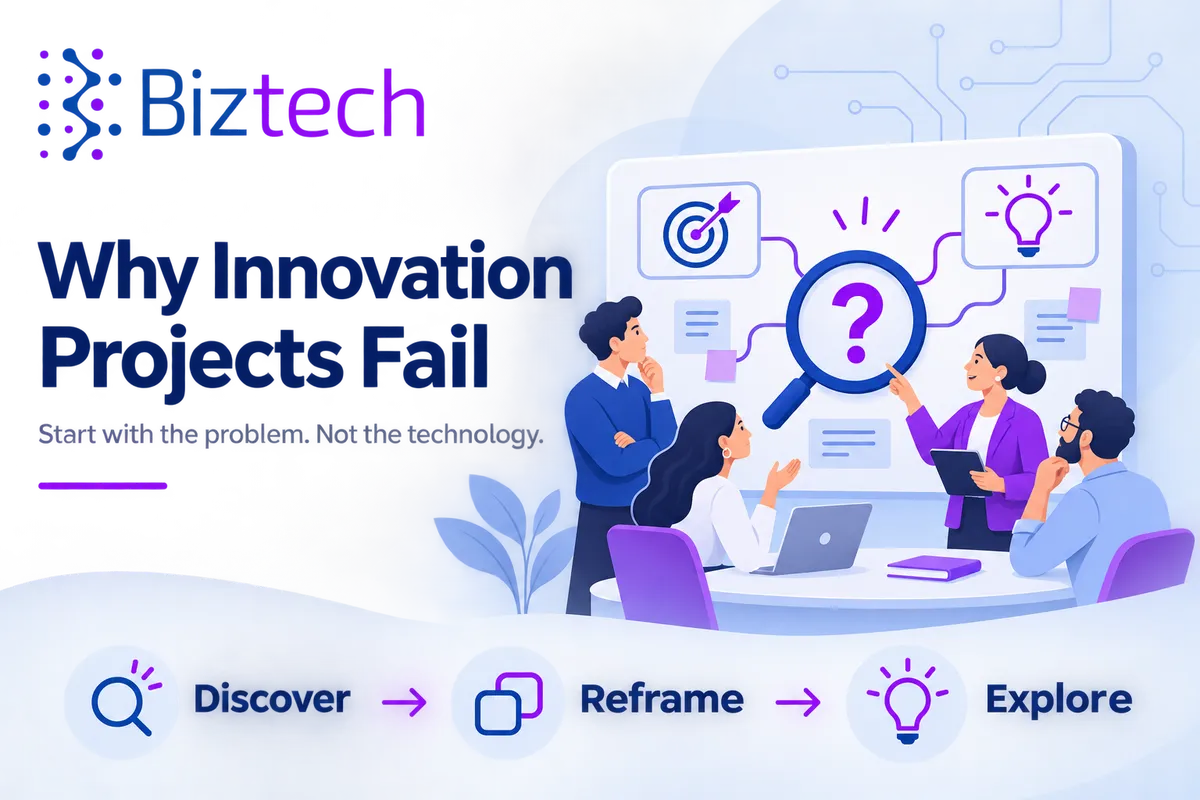
A practical approach typically follows three stages:
Discover
Gather evidence and insight from employees, customers, partners, and stakeholders.
Understand the root causes of the challenge rather than focusing solely on symptoms.
Reframe
Transform the problem into an opportunity statement.
For example:
Instead of:
“How do we deploy AI?”
Consider:
“How can we improve how customer feedback is collected, analysed, and acted upon?”
The second question encourages broader thinking and opens the door to multiple solutions.
Explore
Only after the challenge is understood should organisations begin evaluating technologies, methodologies, or partnerships that can deliver the desired outcome.
This creates a stronger foundation for innovation and significantly reduces the risk of project failure.
Business Innovation Is About People First
One of the most persistent misconceptions about innovation is that it is primarily driven by technology.
Technology is important, but innovation begins with people.
It involves understanding needs, identifying opportunities, exploring possibilities, and creating value in new ways.
The organisations that consistently succeed in business innovation recognise that technology is an enabler rather than the starting point.
They invest time in understanding challenges before committing resources to solutions.
As a result, they achieve better adoption, stronger stakeholder engagement, and greater returns on innovation investment.
The Foundation of a Successful Innovation Strategy
The strongest innovation strategies are built on a simple principle:
Start with the problem, not the solution.
Technology can accelerate progress, but only when organisations have a clear understanding of the challenge they are trying to address.
Before launching your next innovation initiative, ask:
- What problem are we solving?
- Who is affected?
- Why does the issue exist?
- What would success look like?
- How will we measure impact?
The answers to these questions are often more valuable than the technology itself.
When organisations focus first on understanding challenges, they create the conditions for successful innovation, sustainable business transformation, and measurable real-world impact.
Sources and Further Reading:
This article draws on established innovation, design thinking, digital transformation, and project management research, including work published by Harvard Business School, MIT Sloan Management Review, Project Management Institute (PMI), McKinsey & Company, Innovate UK, and leading authors including Peter Drucker, Clayton Christensen, Tim Brown, John Bessant, and Peter Senge.
Frequently Asked Questions About Innovation Project Success
Why do most innovation projects fail?
Most innovation projects fail because organisations focus on implementing solutions before fully understanding the problem they are trying to solve. Common causes include unclear objectives, poor stakeholder engagement, inadequate problem definition, and a lack of measurable success criteria. In many cases, technology works exactly as intended, but it is applied to the wrong challenge.
What is the biggest mistake organisations make when innovating?
The biggest mistake is often starting with a technology rather than a business challenge. Organisations can become excited about artificial intelligence, automation, or digital transformation platforms without first establishing the underlying need. Successful innovation begins by asking the right questions rather than searching for the latest tools.
What is problem-first innovation?
Problem-first innovation is an approach that focuses on understanding challenges before exploring solutions. Instead of asking, “What technology should we implement?” organisations ask, “What problem are we trying to solve?” This helps ensure that innovation efforts remain focused on creating value and achieving measurable outcomes.
How can organisations improve innovation success rates?
Organisations can improve innovation success rates by:
- Clearly defining the challenge
- Engaging stakeholders early
- Establishing measurable objectives
- Exploring multiple solution options
- Testing assumptions before implementation
- Focusing on outcomes rather than technology adoption
This structured approach significantly reduces risk and improves the likelihood of delivering meaningful business impact.
What role does technology play in innovation?
Technology is an enabler rather than the starting point. Effective innovation focuses on solving customer, operational, or market challenges. Once a challenge has been clearly defined, organisations can evaluate whether technologies such as artificial intelligence, advanced analytics, automation, or systems integration can help achieve the desired outcome.
Why is stakeholder engagement important in innovation?
Employees, customers, suppliers, partners, and other stakeholders often see problems from different perspectives. Their input helps organisations uncover root causes, challenge assumptions, identify opportunities, and increase the likelihood that solutions will be adopted successfully.
How do you identify the right innovation opportunities?
Innovation opportunities often emerge from recurring business challenges, customer frustrations, operational inefficiencies, changing market needs, and new technological developments. Structured innovation workshops help organisations explore these challenges and uncover opportunities with the greatest strategic value.
What are the stages of a successful innovation process?
A successful innovation process typically includes:
- Identifying and understanding the challenge
- Gathering evidence and stakeholder insights
- Reframing the challenge as an opportunity
- Exploring potential solutions
- Testing and validating concepts
- Implementing and measuring outcomes
The most successful organisations spend significant time understanding the challenge before committing resources to a specific solution.
How can SMEs innovate with limited resources?
Small and medium-sized enterprises can innovate effectively by focusing on specific business challenges, running small-scale experiments, collaborating with external partners, and testing ideas before making significant investments. Innovation is often more about mindset and process than budget.
What is an Innovation Challenge Workshop?
An Innovation Challenge Workshop is a structured process that brings together stakeholders to identify challenges, explore opportunities, generate ideas, and develop practical solutions. By focusing on the problem before the solution, organisations can improve innovation outcomes and create greater business impact.
About Biztech
Biztech helps organisations drive innovation and create real-world impact through Innovation Workshops, Technology R&D, Systems Integration, and Practical Training.
Our Innovation Challenge Workshops bring together leaders, practitioners, and stakeholders to identify challenges, uncover opportunities, and develop practical pathways to innovation and growth.
Ready to tackle your next innovation challenge? Contact Biztech to learn how a problem-first approach can unlock new opportunities for your organisation.
